Chippewa County Dog Registration Information
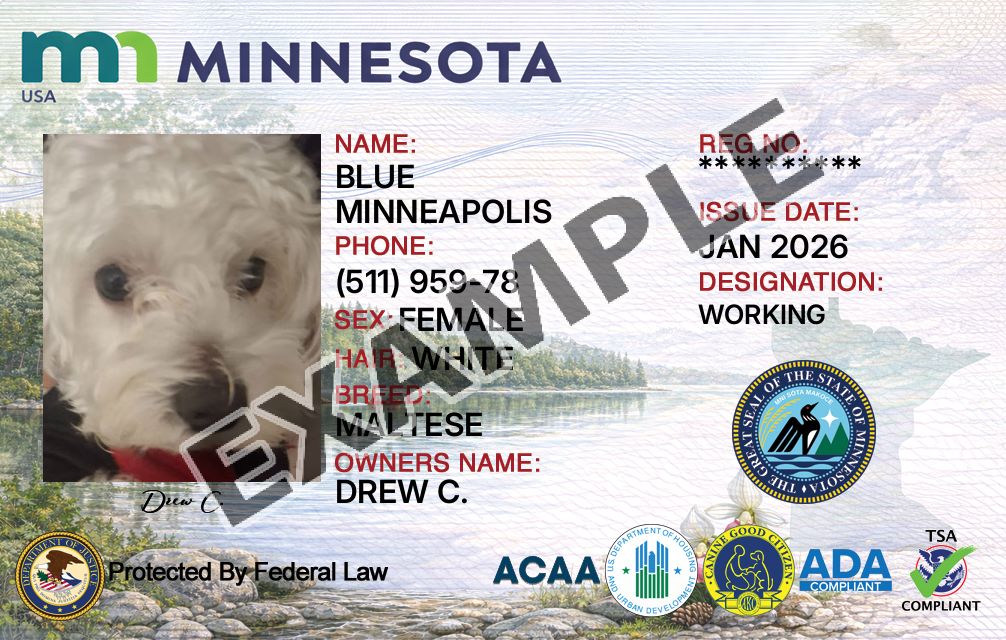
Service Dogs and Emotional Support Animals in Chippewa, Minnesota
If you’re asking where do I register my dog in Chippewa County, Minnesota for my service dog or emotional support dog, the key thing to know is this: service dogs and emotional support animals (ESAs) are not “registered” with the county in the way many people expect. What most residents actually need is a dog license in Chippewa County, Minnesota through the local city or local law enforcement/animal control office where they live.
This page explains where to register a dog in Chippewa County, Minnesota, how local licensing works, what rabies documentation is usually required, and the important legal differences between a dog license, a service dog, and an emotional support animal.
Where to Register or License Your Dog in Chippewa County, Minnesota
Because dog licensing is often handled locally, below are several official offices in Chippewa County, Minnesota that are commonly relevant to dog licensing, animal control questions, stray/impound processes, or local enforcement. Contact the office that matches where you live (city residents should start with their city office).
City of Montevideo Police Department (Dog/Cat License)
Address:
103 Canton Ave
Montevideo, MN 56265
Phone: (320) 269-8808
Email: mailbox@montevideopolice.com
Office hours: Not listed for the licensing page (call to confirm licensing counter hours)
Chippewa County Sheriff’s Office (Guidance for Unincorporated Areas)
Address:
Law Enforcement Center
629 N 11th Street, Suite 14
Montevideo, MN 56265
Phone: (320) 269-2121
Office hours:
Monday–Friday, 8:00 a.m. – 4:30 p.m.
City of Watson (City Clerk / Treasurer)
Mailing address:
P.O. Box 7
Watson, MN 56295
Phone: (320) 269-8543
Email: cityclerk@cityofwatson.us
Office hours:
Monday–Friday, 10:00 a.m. – 2:00 p.m.
City of Montevideo (City Hall)
Address:
103 Canton Avenue
Montevideo, MN 56265
Phone: (320) 269-6575
Office hours:
Monday–Friday, 8:00 a.m. – 4:30 p.m.
Overview of Dog Licensing in Chippewa County, Minnesota
What “registering your dog” usually means
In everyday use, “registering” a dog usually means getting a local dog license and a tag. A local license helps animal control or law enforcement identify the owner if a dog is found loose, involved in a complaint, or impounded. When residents search for an animal control dog license Chippewa County, Minnesota, they’re typically looking for the city office or local authority that issues tags and keeps the owner record.
County vs. city responsibility (why the answer depends on your address)
Chippewa County includes multiple communities and rural areas. Minnesota dog licensing is commonly handled by cities through their local ordinances and designated offices (often the police department, city clerk, or a contracted animal control function). That’s why the best answer to where to register a dog in Chippewa County, Minnesota starts with: Are you inside city limits?
Rabies documentation matters
Most licensing programs require proof that your dog is currently vaccinated for rabies. In practice, that means you should be ready to show a veterinary rabies certificate (or other official proof) when applying, renewing, or replacing a license tag. Even when a webpage says “vaccination certificate,” it typically includes rabies vaccination details.
How Dog Licensing Works Locally in Chippewa County, Minnesota
Step 1: Identify the correct licensing office for your address
Start by determining whether you live within a city (like Montevideo or Watson) or in an unincorporated/rural area. If you live in a city, that city’s designated office is usually the correct starting point. For example, the Montevideo Police Department states that dog/cat licenses can be purchased through the department, which is a common model for municipal licensing.
Step 2: Gather the documents most offices request
While the exact requirements and fees vary by city ordinance, most local licensing counters ask for:
- Proof of current rabies vaccination (often part of your pet’s vaccination certificate)
- Owner identification (photo ID may be requested depending on the office)
- Proof of residency (especially if the license is limited to residents inside the city)
- Payment for the licensing fee (fees and renewals are set locally)
Step 3: Apply, renew, and keep the tag on your dog
Once issued, license tags should be worn on the dog’s collar (or kept attached as required by local ordinance). Renewal timing varies. Some cities use annual licensing cycles, while others allow multi-year licensing depending on local rules and rabies vaccine expiration dates.
What if you’re outside city limits?
If you’re not sure which local authority handles licensing where you live, call the Chippewa County Sheriff’s Office during business hours and ask who administers licensing for your township or address. This is especially helpful for rural residents who may have different processes than city residents.
Service Dog Laws in Chippewa County, Minnesota
Service dog legal status is not the same as a dog license
A dog license is a local government requirement (city/township ordinance) tied to identification, rabies compliance, and animal control enforcement. A service dog, by contrast, is defined by what the dog is trained to do for a person with a disability and is governed by disability access laws. In other words, you can have a fully legitimate service dog and still need a local license tag if your local ordinance requires licensing.
No official “service dog registration” is required for public access
Many people search for “service dog registration,” but public access rights are based on the dog’s status as a trained service animal, not on a purchased registry certificate. Local offices in Chippewa County generally handle licensing (tags, rabies proof, local records), not “service dog certification.”
Practical tips for service dog owners dealing with licensing
- Ask your local office whether there are any fee reductions or documentation differences for service animals under the local ordinance (not every jurisdiction offers this).
- Keep rabies vaccination proof current and readily available; it’s often the most important licensing document.
- If you’re dealing with housing, employment, or public access questions, understand those rules are separate from licensing and may involve different legal standards.
Emotional Support Animal Rules in Chippewa County, Minnesota
An ESA is not a service dog
An emotional support animal (ESA) provides comfort by its presence, but it is not the same as a service dog that is trained to perform specific tasks related to a disability. This difference matters because the rules for public access, workplace accommodations, and housing can be different depending on the setting and the applicable law.
ESA “registration” does not replace a local dog license
If you live in Chippewa County and your dog is an ESA, you typically still follow the same process to obtain a dog license in Chippewa County, Minnesota through your city or local office. Online “registries” are not a substitute for a local license tag or rabies compliance.
Rabies, local animal control, and ESAs
Even when a dog is an ESA, local animal control and rabies-related rules can still apply. If your dog is found loose or involved in a bite incident, your local licensing record and rabies documentation can be important for quickly resolving the situation.
Frequently Asked Questions
In most cases, yes—if your city or local jurisdiction requires licensing for dogs, the requirement generally applies regardless of whether your dog is a pet, service dog, or ESA. Contact your local office (for example, your city police department or clerk) and ask whether the local ordinance provides any exemption or special process.
If you live in Montevideo, start with the City of Montevideo Police Department, which indicates that dog/cat licenses can be purchased there. If you’re unsure whether licensing is handled at the police department counter or through another city office, call City Hall for confirmation.
Most offices ask for a current vaccination certificate or rabies certificate from your veterinarian showing the rabies vaccination date and expiration. If your dog’s rabies status is not current, most offices will not complete a license transaction until it is updated.
Many residents expect a single countywide licensing office, but licensing is often handled locally by cities (and sometimes townships). If you’re outside city limits or don’t know the correct office, call the Chippewa County Sheriff’s Office and ask who administers licensing for your address.
For local licensing and rabies compliance, you typically only need to work with your local government office and your veterinarian’s documentation. Public access rights for service dogs are based on the dog’s training and role, not on a purchased registry certificate. If you need clarity about what your city requires for licensing, contact the local office listed above.
Register A Dog In Other Minnesota Counties
Select your county below to get started with your dog’s ID card. Requirements and license designs may vary by county, so choose your location to see the correct options and complete your pup’s registration.
- Aitkin County Dog Registration
- Anoka County Dog Registration
- Becker County Dog Registration
- Beltrami County Dog Registration
- Benton County Dog Registration
- Big Stone County Dog Registration
- Blue Earth County Dog Registration
- Brown County Dog Registration
- Carlton County Dog Registration
- Carver County Dog Registration
- Cass County Dog Registration
- Chisago County Dog Registration
- Clay County Dog Registration
- Clearwater County Dog Registration
- Cook County Dog Registration
- Cottonwood County Dog Registration
- Crow Wing County Dog Registration
- Dakota County Dog Registration
- Dodge County Dog Registration
- Douglas County Dog Registration
- Faribault County Dog Registration
- Fillmore County Dog Registration
- Freeborn County Dog Registration
- Goodhue County Dog Registration
- Grant County Dog Registration
- Hennepin County Dog Registration
- Houston County Dog Registration
- Hubbard County Dog Registration
- Isanti County Dog Registration
- Itasca County Dog Registration
- Jackson County Dog Registration
- Kanabec County Dog Registration
- Kandiyohi County Dog Registration
- Kittson County Dog Registration
- Koochiching County Dog Registration
- Lac qui Parle County Dog Registration
- Lake County Dog Registration
- Lake of the Woods County Dog Registration
- LeSueur County Dog Registration
- Lincoln County Dog Registration
- Lyon County Dog Registration
- Mahnomen County Dog Registration
- Marshall County Dog Registration
- Martin County Dog Registration
- McLeod County Dog Registration
- Meeker County Dog Registration
- Mille Lacs County Dog Registration
- Morrison County Dog Registration
- Mower County Dog Registration
- Murray County Dog Registration
- Nicollet County Dog Registration
- Nobles County Dog Registration
- Norman County Dog Registration
- Olmsted County Dog Registration
- Otter Tail County Dog Registration
- Pennington County Dog Registration
- Pine County Dog Registration
- Pipestone County Dog Registration
- Polk County Dog Registration
- Pope County Dog Registration
- Ramsey County Dog Registration
- Red Lake County Dog Registration
- Redwood County Dog Registration
- Renville County Dog Registration
- Rice County Dog Registration
- Rock County Dog Registration
- Roseau County Dog Registration
- Scott County Dog Registration
- Sherburne County Dog Registration
- Sibley County Dog Registration
- St. Louis County Dog Registration
- Stearns County Dog Registration
- Steele County Dog Registration
- Stevens County Dog Registration
- Swift County Dog Registration
- Todd County Dog Registration
- Traverse County Dog Registration
- Wabasha County Dog Registration
- Wadena County Dog Registration
- Waseca County Dog Registration
- Washington County Dog Registration
- Watonwan County Dog Registration
- Wilkin County Dog Registration
- Winona County Dog Registration
- Wright County Dog Registration
- Yellow Medicine County Dog Registration